Skip to product information
1 of 1

Soft Solder Fluxes

Soft Solder Fluxes

GS Metal Joining supplies a range of soft solder fluxes for general engineering, plumbing, electronics and aluminium soldering applications. Correct flux selection for soft soldering follows the same principle as brazing flux selection — the flux must be matched to the base metals and working temperature to be effective.
View full details

Flux specifications

Flux classification per EN29454 (ISO 9454). All soft solder fluxes require adequate ventilation during use — flux fumes are an irritant and must not be inhaled. Residue removal requirements vary by product — see individual product guidance below.

ProductClassificationFormResidue removalSuited to
Stay-CleanType 2 (organic acid)LiquidRequired — wash with waterCopper, brass, general soldering and plumbing
Stay-Clean AluminiumType 3 (inorganic acid)LiquidRequired — wash thoroughlyAluminium soft soldering with compatible alloys
XP712Type 1 (rosin-based, no-clean)LiquidNot required (no-clean)Electronics and electrical soldering, PCB work
  • Stay-Clean — General purpose liquid flux

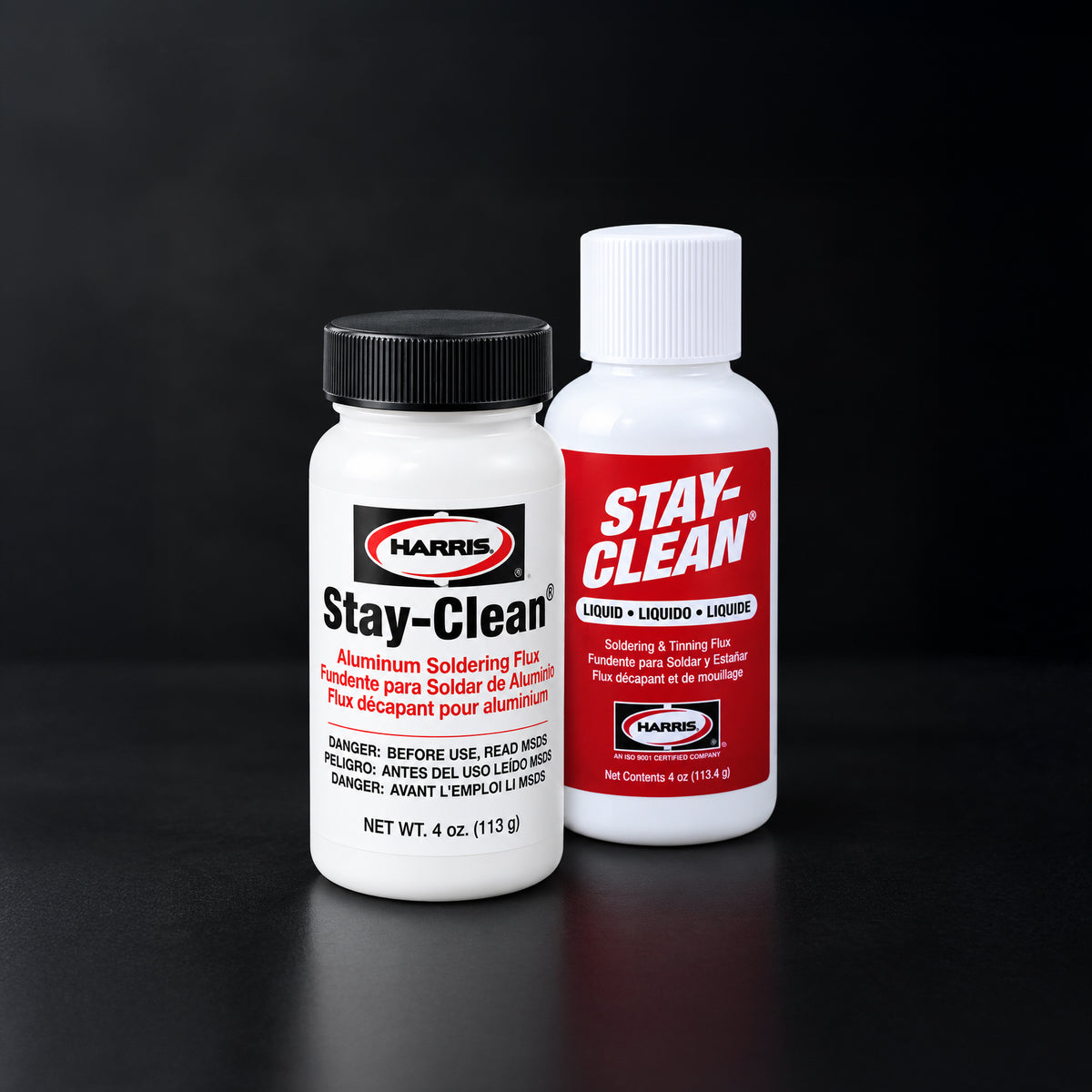
    Organic acid, liquid, operating temperature up to 371°C. The standard flux for soft soldering copper pipework, fittings and general fabrication — the most widely used product in our soft solder flux range. Applied by brush or applicator to the joint before heating. Active and highly effective on copper and copper alloys. Residue is corrosive and must be removed after soldering by washing with warm water. Use with 96S, 99C, Alloy G, Alloy F or Alloy K. Adequate ventilation is essential during use.

  • Stay-Clean Aluminium — Aluminium soldering flux

    Inorganic acid, liquid, operating temperature 177–288°C. Standard fluxes will not wet aluminium — the stable aluminium oxide layer reforms almost instantly and prevents solder adhesion without a specifically formulated flux. Stay-Clean Aluminium is the correct specification for soft soldering aluminium with compatible alloys (Alusol, 2207). Residue is highly corrosive and must be thoroughly removed after soldering with warm water. Not for use on copper or brass — use Stay-Clean for those base metals.

  • XP712 — No-clean electronics flux

    Rosin-based, no-clean, liquid, for electronics work. Formulated for electronics and PCB soldering where flux residue removal after soldering is not practical or desirable. Leaves a minimal, electrically non-conductive, non-corrosive residue compatible with most conformal coatings — no post-solder cleaning required. Applied by brush or dispenser to the joint or pad before soldering. Use with lead free or lead bearing electronics-grade solder. Adequate ventilation is essential — no-clean does not mean no fumes.

Flux residue — why removal matters

Most soft solder fluxes leave a residue that is actively corrosive in service — particularly in damp environments. Failure to remove flux residue is one of the most common causes of premature joint failure and pipe corrosion in plumbing and fabrication applications.

  • Stay-Clean — wash off with warm water immediately after soldering, before the residue dries and hardens. A wire brush will remove stubborn residue. Do not leave on the joint.
  • Stay-Clean Aluminium — the residue is particularly aggressive and must be washed off thoroughly with warm water as soon as the joint has cooled. Inadequate removal will corrode the aluminium base metal in service.
  • XP712 — no-clean formulation; residue does not need to be removed and is safe to leave in place. It is electrically non-conductive and compatible with most conformal coatings. However, if cosmetic appearance of the joint is important, residue can be removed with isopropyl alcohol (IPA).

Frequently asked questions

Which flux should I use for copper plumbing?

Stay-Clean liquid flux is the standard specification for soft soldering copper pipework and fittings. Apply by brush to both mating surfaces before heating, heat the joint evenly, and feed solder into the joint once the flux becomes active. Remove flux residue with warm water after soldering. Use with 96S or 99C (lead-free), or Alloy K (60/40) where a lead-bearing solder is permitted. Do not use Stay-Clean Aluminium on copper — it is formulated for aluminium and is unnecessarily aggressive on standard base metals.

Can I use Stay-Clean flux on aluminium?

No. Stay-Clean is formulated for copper and copper alloys and will not adequately penetrate the aluminium oxide layer to allow solder to wet aluminium. For aluminium soft soldering, specify Stay-Clean Aluminium flux with a compatible aluminium solder (Alusol or 2207). Stay-Clean Aluminium contains more aggressive inorganic acids specifically chosen to attack the aluminium oxide layer — this is also why its residue must be thoroughly removed after soldering.

What does 'no-clean' mean for XP712?

No-clean means the flux residue left after soldering does not need to be removed — it is electrically non-conductive, non-corrosive, and compatible with most conformal coatings used in electronics assembly. This is important in electronics work where cleaning solvents could damage components or where access to the joint after assembly is limited. However, no-clean does not mean no fumes — XP712 produces flux fumes during soldering that must not be inhaled. Always use adequate ventilation or local exhaust extraction when soldering.

Do I need flux if I'm using flux-cored solder wire?

Flux-cored solder wire contains an integrated flux core that releases flux as the wire melts — no separate flux application is required for most electronics work. However, for plumbing and fabrication soldering (where solid bar or plain wire solder is standard), a separate flux such as Stay-Clean must be applied to the joint before heating. If you are unsure whether your solder wire is flux-cored or plain, check the product specification — and if soldering copper pipework, apply Stay-Clean regardless as additional insurance against dry joints.

How do I remove Stay-Clean flux residue?

Wash off with warm water as soon as the joint has cooled to a safe handling temperature — ideally immediately after soldering, before the residue dries and hardens. A wire brush will remove stubborn hardened residue. For Stay-Clean Aluminium, wash thoroughly and check that all residue has been removed — the inorganic acid residue is particularly aggressive and will corrode aluminium in service if left in place. Do not use acid-based fluxes near sealed systems or in locations where thorough washing is not possible.

Are soft solder fluxes safe to use?

All soft solder fluxes produce fumes during soldering that are an irritant and must not be inhaled. Always work with adequate ventilation — ideally local exhaust extraction (LEE) positioned to draw fumes away from the breathing zone. Stay-Clean and Stay-Clean Aluminium are liquid acid-based fluxes — avoid skin and eye contact and wash hands after use. Full safety data sheets (SDS) are available for all products on request. XP712 is no-clean but still produces fumes — ventilation is required.

  • Certified materials

    All soft solder fluxes are classified to EN29454 (ISO 9454) and manufactured to consistent composition standards. Fully COSHH compliant. Safety data sheets available on request for all products.

  • Technical expertise

    Over 110 years of combined experience across the full range of joining processes. We advise on flux selection, base metal compatibility, residue removal and COSHH compliance — from plumbing and fabrication to electronics assembly.

  • Competitive pricing

    As a focused, efficient business with tightly controlled overheads, we offer genuinely competitive pricing at every order size — from individual bottles to volume trade and production quantities.

  • LINBRAZE partnership

    As UK representative of LINBRAZE S.R.L. of Italy, we provide access to a world-leading manufacturer of brazing pastes and specialist flux formulations for industrial and automated applications.