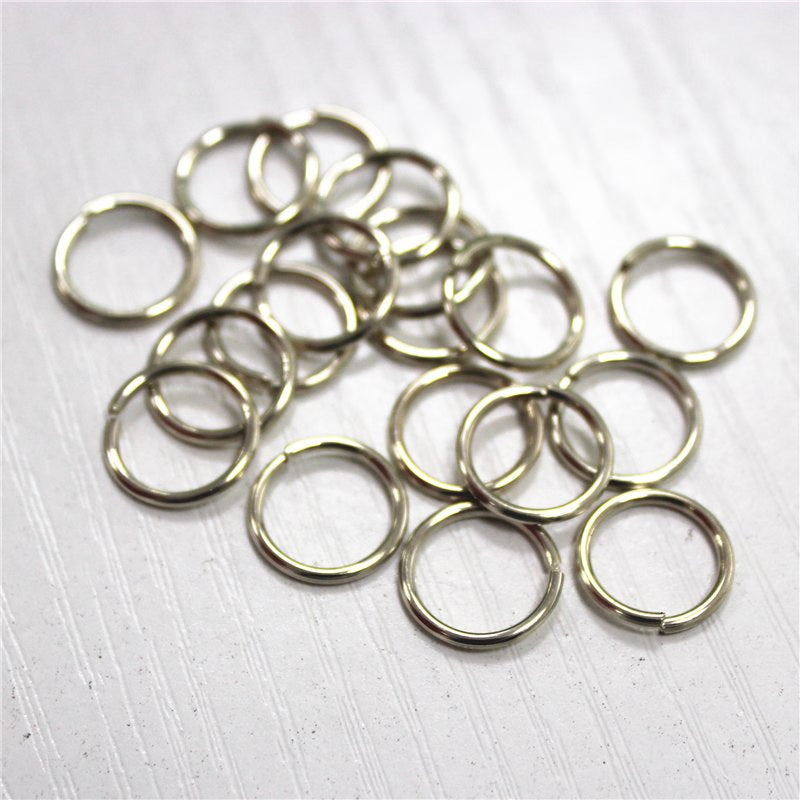
Brazing Rings and Preforms

What is a brazing preform?
A brazing preform is a piece of brazing alloy formed to a specific shape and weight — typically a ring, washer, disc or strip — that is placed in or around the joint prior to assembly and heating.
When the assembly reaches brazing temperature, the preform melts and flows into the joint by capillary action. The alloy quantity and position are fixed by design rather than by operator judgement, producing consistent, repeatable joints across a production run.
Standard preform types
-
Rings and collars
The standard preform for tubular joints. The ring sits around the tube at the mouth of the fitting before assembly. On heating, it melts and is drawn into the joint gap by capillary action. Available in a range of internal diameters and cross-sectional weights to suit different tube sizes and alloy requirements.
-
Washers and discs
For flat lap joints and face joints. The washer or disc is placed between the two mating surfaces before assembly. Weight is calculated to provide the correct alloy volume for the joint area.
-
Strip and cut preforms
Cut from strip or wire to a specified length and weight for joints where a standard ring or washer form does not suit the geometry.
-
Custom preforms
Produced to customer drawings for complex or unusual joint geometries. We can produce preforms in any shape that can be formed from strip, wire or sheet alloy. Contact us with your joint geometry and we will advise on the most appropriate preform form.
Available alloys
Preforms are available in all standard silver brazing alloys (AG103, AG105, AG106, AG107, AG205, AG206, AG207, L-AG45SnSi), copper phosphorus alloys (CP101–CP105, CP201–CP203), and soft solders. Contact us to confirm availability in the specific alloy and form required.
When to specify preforms
Preforms are the recommended specification for production brazing where the same joint is being brazed repeatedly, induction brazing where rod cannot be fed manually during the heating cycle, furnace brazing where alloy must be pre-placed before the heating cycle begins, automated and semi-automated brazing processes, applications where joint aesthetics are critical and fillet size must be controlled, and high-integrity applications where consistent alloy quantity must be demonstrated and documented.
For one-off, low-volume or maintenance work, rod or wire remains the practical choice.
Process benefits
Switching from hand-fed rod to preforms in a production environment typically delivers consistent alloy quantity per joint and elimination of over- or under-filling, reduced alloy waste through precise volume control, simplified operator technique with one fewer manual step in the brazing cycle, easier quality control and joint inspection, and compatibility with automated heating processes.
Specifying a preform
To specify a standard or custom preform, provide the joint geometry (internal diameter for rings, face dimensions for washers, joint cross-section for custom forms), the alloy grade required, the required alloy volume or weight per joint if known, and the quantity required.
For complex geometries, a drawing or sample component is helpful. Contact our technical team and we will advise on the most appropriate preform form, alloy and weight.
Frequently asked questions
What is the difference between a brazing ring and a brazing preform?
A brazing ring is a specific type of preform — a circle or collar of brazing alloy wire formed to sit around a tube or pipe at the mouth of a socket fitting before assembly. The term preform covers a broader range of shapes including rings, washers, discs, strips and custom forms. In practice the terms are often used interchangeably for tubular joint applications, but preform is the correct general term for any alloy shape produced to a defined geometry and weight for pre-placement at a joint.
How do I specify the correct ring size for a tubular joint?
The internal diameter of the ring should match the outside diameter of the tube it sits around, with sufficient clearance to locate cleanly without sliding. The cross-sectional weight of the ring — determined by the wire diameter from which it is formed — should be calculated to provide the correct volume of alloy to fill the joint gap for the socket depth. To specify a ring, provide the tube outside diameter, socket depth and alloy grade required. If you are unsure of the correct wire cross-section for your joint, our technical team can calculate the required alloy volume and advise on the appropriate ring specification.
Which alloys are available as preforms and rings?
Preforms and rings are available in all standard silver brazing alloys including AG103, AG105, AG106, AG107, AG205, AG206, AG207 and L-AG45SnSi, silver copper phosphorus alloys including CP101 through CP105, copper phosphorus alloys including CP201 through CP203, and soft solders. If you require a preform in an alloy not listed, contact us — virtually any alloy available in wire or strip form can be produced as a preform.
Do preforms require flux?
Yes, in most cases. Preforms are formed from standard brazing alloy and require the same flux as the equivalent bare rod or wire. For silver brazing alloy preforms on copper, brass and mild steel, apply GS30 general-purpose paste flux to the joint surfaces before assembly. For stainless steel, nickel alloys or tungsten carbide, use Stay-Silv Black flux. For silver copper phosphorus alloy preforms on copper-to-copper joints, no flux is required — these alloys are self-fluxing on copper in air. Ensure flux is applied to the full depth of the joint, not just at the entry point.
Can preforms be used in induction and furnace brazing?
Yes — preforms are the standard alloy form for both induction and furnace brazing. Induction brazing heats the joint too rapidly for rod to be fed manually, and furnace brazing requires all materials to be pre-placed before the heating cycle begins. Preforms deliver a defined alloy volume in a fixed position, making them compatible with both processes. For induction brazing in particular, ring preforms that locate accurately around the tube at the socket mouth are the most reliable and repeatable specification. Brazing paste is an alternative where joint geometry makes preform placement difficult — see our brazing paste page for details.
How do preforms improve consistency in production brazing?
With hand-fed rod, alloy quantity and placement depend on operator judgement and vary between operators and between joints. A preform of defined weight delivers exactly the same alloy volume to exactly the same position every time, regardless of operator. This eliminates the two most common sources of joint-to-joint variability — inconsistent alloy quantity and inconsistent alloy placement — and makes it straightforward to demonstrate process control for quality management purposes. Switching from rod to preforms typically reduces alloy waste, reduces rejected joints from overfilling or underfilling, and simplifies operator technique by removing the need to feed rod during the heating cycle.
Can you supply custom preforms to our drawing or specification?
Yes. We produce custom preforms in any shape that can be formed from wire, strip or sheet alloy, including non-standard ring diameters, washers and discs to specific face dimensions, and cut strip preforms for irregular joint geometries. To specify a custom preform, provide a drawing or sketch of the joint geometry, the alloy grade required, the required alloy volume or weight per joint if known, and the quantity. For complex geometries, a sample component is helpful. Contact our technical team to discuss your requirements and we will advise on the most practical preform form and alloy specification.
What is the minimum order quantity for preforms and rings?
We do not impose a minimum order quantity. We supply preforms to both small users and high-volume production customers. For custom preforms produced to a specific drawing or specification, tooling or set-up requirements may influence the most economical order quantity — our technical team will advise on this when quoting. Contact us with your specification and required quantity for a prompt, competitive quote.
Why Choose GS Metal Joining?
-
Certified materials
All our silver brazing alloys conform to EN1044. We use only virgin raw materials to ensure full RoHS and COSHH compliance.
-
Technical expertise
We can advise on alloy and flux selection, joint design, brazing technique and process troubleshooting. Our technical knowledge of the market ensures you get the most from your brazing materials.
-
Competitive pricing
Small overheads mean we are not carrying the cost burden of a large corporate. That saving is passed directly to our customers, at every order size.
-
LINBRAZE partnership
As UK representative of LINBRAZE S.R.L. (Italy), a world-leading manufacturer of metal powders and brazing pastes, we can supply specialist forms including high-quality pastes, powders and granules for automated and precision applications.