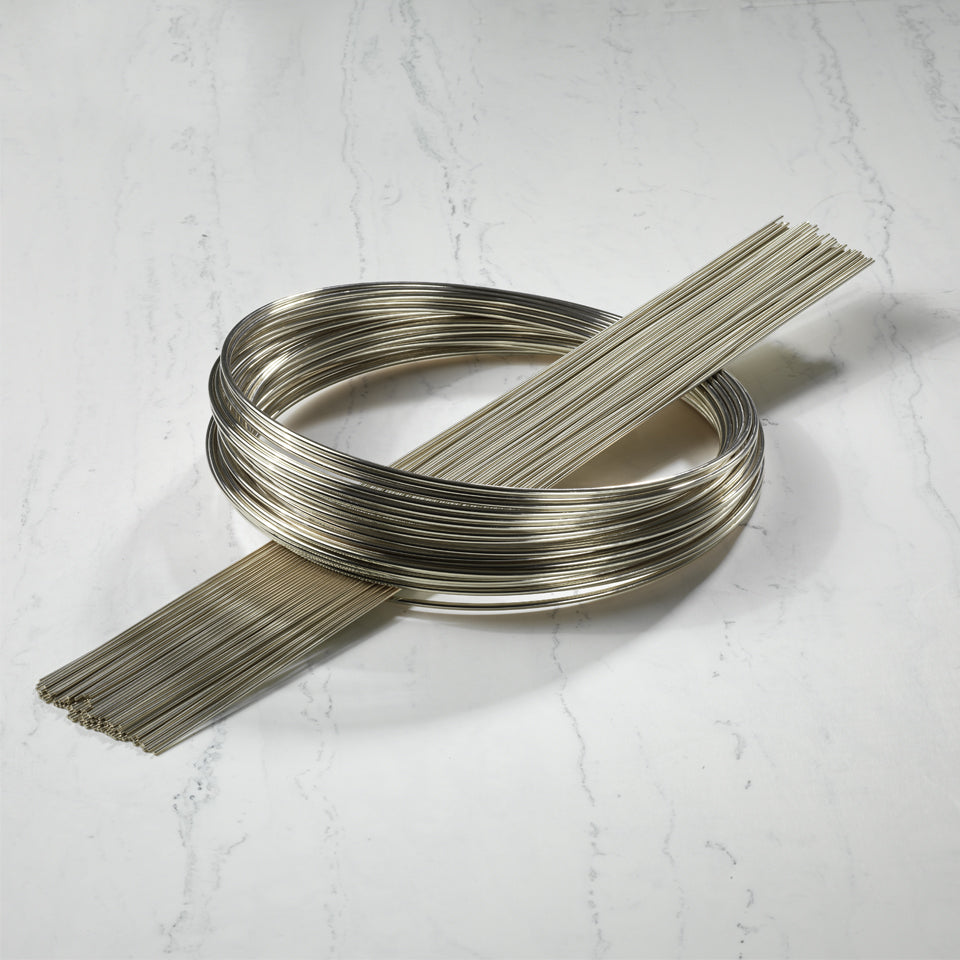
Cadmium-Free Silver Brazing Alloys
GS Metal Joining supplies a comprehensive range of cadmium-free silver brazing alloys, manufactured to EN1044 standards using only virgin raw materials.
Fully RoHS and COSHH compliant, our alloys are suitable for joining a wide range of similar and dissimilar metals across demanding industrial applications — from refrigeration and HVAC to aerospace and military.
All alloys are available as bare rods, flux-coated rods, wire, strip, foil, preforms, powder and paste. Non-stock forms are available to order.

Why cadmium-free?
EU legislation has progressively restricted cadmium in brazing alloys due to its toxicity. The removal of cadmium does alter brazing characteristics — most notably a reduction in fluidity and an increase in melting temperatures — but these are countered by increasing the silver content of the alloy used.
To comply with current COSHH and RoHS regulations, all GS Metal Joining silver solders are manufactured exclusively from virgin raw materials, ensuring full conformance with cadmium content limits.
Alloy range
Our range spans silver content from 12% through to 55%, allowing selection by melting range, joint strength, fluidity and cost requirements. Higher silver content lowers the melting point, improves flow characteristics, and increases joint ductility — making it the primary variable when selecting an alloy for a specific application.
All alloys conform to EN1044. Tin additions improve flow characteristics. Silicon additions are used for joining stainless steel and other difficult-to-braze metals, and manganese and nickel additions (AG502) enhance flow and wetting on tungsten carbide.
| EN1044 | % Silver | % Copper | % Zinc | % Other | Melting range |
|---|---|---|---|---|---|
| AG103 | 55 | 21 | 22 | 2.0 Sn | 630–660°C |
| AG105 | 40 | 30 | 28 | 2.0 Sn | 650–710°C |
| AG106 | 34 | 36 | 27.5 | 2.5 Sn | 630–730°C |
| AG107 | 30 | 36 | 32 | 2.0 Sn | 665–755°C |
| AG205 | 25 | 40 | 35 | – | 700–790°C |
| AG206 | 20 | 44 | 36 | 0.15 Si | 800–830°C |
| AG207 | 12 | 48 | 40 | 0.15 Si | 820–870°C |
| AG502 | 49 | 16 | 23 | 4.5 Ni, 7.5 Mn | 680–705°C |
| L-AG45SnSi | 45 | 24.75 | 27 | 3.0 Sn, 0.25 Si | 640–680°C |
Choosing the right alloy
-
AG103
55% silver. The most versatile general-purpose alloy in the range. Lowest melting point (630–660°C), excellent fluidity, and works reliably with GS30 flux on most base metals. The recommended starting point for new applications.
-
AG105 & AG106
40% and 34% silver respectively. Good flow characteristics with a cost reduction over AG103. Suitable for general engineering and HVAC applications where a slightly wider melting range is acceptable.
-
AG107
30% silver. A popular mid-range alloy widely used in refrigeration and air conditioning for copper and copper alloy joints. Good fluidity and a reliable working range of 665–755°C.
-
AG205 & AG206
25% and 20% silver respectively. Economy grades suited to less critical joints where a higher brazing temperature is acceptable. AG206 contains silicon, which helps suppress zinc fuming at elevated temperatures.
-
AG207
12% silver. The lowest-cost alloy in the range, intended for high-volume applications where the higher brazing temperature (820–870°C) can be managed. Not recommended where joint ductility is a requirement.
-
L-AG45SnSi & AG502
45% and 49% silver respectively. L-AG45SnSi (640–680°C) gives good flow on stainless steel and nickel alloys. In AG502 (680–705°C), the addition of manganese and nickel enhances flow and wetting on tungsten carbide.
Compatible base metals
Cadmium-free silver brazing alloys are suitable for joining copper, brass, bronze, mild steel, carbon steel, stainless steel, nickel alloys and tungsten carbide, including dissimilar combinations of these metals.
They are not suitable for aluminium, zinc-based alloys or certain refractory metals. See our aluminium alloys page for joining aluminium.
Flux selection
Selecting the correct flux is as important as alloy selection — an incorrect flux is the most common cause of poor alloy flow regardless of technique.
For most standard alloys (AG103 through AG205) on copper, brass and mild steel, GS30 general-purpose paste flux is the correct choice, active to 800°C (FH10). For higher-temperature alloys including AG206 and AG207, specify GSHT5, active to 1000°C (FH20).
For stainless steel, nickel alloys and tungsten carbide, Stay-Silv Black is required — active to 982°C (FH12), formulated to remove the stable oxide layers that standard flux cannot penetrate. Stay-Silv White is a general-purpose paste alternative to GS30, active to 871°C (FH10).
Standards, approvals and applications
All cadmium-free silver brazing alloys in our range conform to EN1044. Materials also conform to BS1845 and EN17672 as applicable. All alloys are manufactured from virgin raw materials and are fully RoHS and COSHH compliant.
Our alloys are used across refrigeration and commercial cooling, HVAC and air conditioning, aerospace, military and defence, shipbuilding, automotive and motorsport, and general engineering fabrication. Contact us to discuss certification and documentation requirements for your specific application or sector.
Frequently asked questions
Why do cadmium-free alloys have a higher silver content than older grades?
Cadmium was used in older brazing alloys to improve fluidity and lower the melting point. Its removal under RoHS and COSHH legislation reduced fluidity and increased melting temperatures across the range. Increasing the silver content compensates directly — higher silver lowers the melting point, improves flow and increases joint ductility. This is why modern cadmium-free grades such as AG103 (55% silver, 630–660°C) perform comparably to the cadmium-bearing alloys they replaced. All GS Metal Joining alloys are manufactured from virgin raw materials to ensure full RoHS and COSHH compliance.
What is the difference between AG103, AG105 and AG107?
All three are general-purpose cadmium-free silver brazing alloys conforming to EN1044, differentiated primarily by silver content and melting range. AG103 contains 55% silver and melts at 630–660°C, giving the best fluidity and the narrowest melting range in the standard range — it is the most forgiving alloy to use in production. AG105 (40% silver, 650–710°C) and AG107 (30% silver, 665–755°C) offer progressively lower silver content and higher melting ranges. Where the wider working range and reduced fluidity of AG105 or AG107 are acceptable, they offer a meaningful cost reduction over AG103 without significant compromise in joint quality.
Which alloy and flux combination should I specify for stainless steel?
For stainless steel, specify L-AG45SnSi with Stay-Silv Black paste flux. L-AG45SnSi contains tin and silicon additions (3.0% Sn, 0.25% Si) that improve wetting on difficult-to-braze base metals, with a melting range of 640–680°C. Stay-Silv Black is specifically formulated for stainless steel, nickel alloys and tungsten carbide. AG206 (20% silver, 800–830°C) with GSHT5 flux is an alternative where a lower silver content is preferred and the higher working temperature is manageable.
When should I specify AG206 or AG207 over higher-silver grades?
AG206 (20% silver, 800–830°C) and AG207 (12% silver, 820–870°C) are economy grades suited to high-volume production on less critical joints where working at higher brazing temperatures is not a constraint. Both contain 0.15% silicon, which suppresses zinc fuming at elevated temperatures. They are not recommended where joint ductility is important, where base metal temperature sensitivity is a factor, or where the wider melting range would make the brazing process difficult to control. For most precision or structural applications, AG103 through AG107 are the appropriate choice.
What base metals are our alloys qualified for, and what are the exceptions?
Our cadmium-free silver brazing alloys are suitable for copper, brass, bronze, mild steel, carbon steel, stainless steel, nickel alloys and tungsten carbide, including dissimilar metal combinations. They conform to EN1044 and are RoHS compliant. They are not suitable for aluminium, zinc-based alloys or certain refractory metals — aluminium's highly stable surface oxide and proximity of its melting point to brazing temperatures requires a dedicated alloy range. See our aluminium alloys page for Al12Si, Alusol and Technoweld options.
What forms are available, and what is the minimum order?
Bare rods and wire are standard stock across the range. Flux-coated rods are available in 1.5mm and 2.0mm diameter and above for all standard grades. Strip, foil, preforms, powders and pastes are non-stock items available to order in all alloys. Preforms are particularly suited to automated brazing and precision production environments where alloy quantity and placement need to be tightly controlled. We supply both small users and volume distributors — contact us with your requirements for a quote at any order size.
Why Choose GS Metal Joining?
-
Certified materials
All our silver brazing alloys conform to EN1044. We use only virgin raw materials to ensure full RoHS and COSHH compliance.
-
Technical expertise
We can advise on alloy and flux selection, joint design, brazing technique and process troubleshooting. Our technical knowledge of the market ensures you get the most from your brazing materials.
-
Competitive pricing
Small overheads mean we are not carrying the cost burden of a large corporate. That saving is passed directly to our customers, at every order size.
-
LINBRAZE partnership
As UK representative of LINBRAZE S.R.L. (Italy), a world-leading manufacturer of metal powders and brazing pastes, we can supply specialist forms including high-quality pastes, powders and granules for automated and precision applications, as well as for decorative metal spraying.