Skip to product information
1 of 1

Brazing and Soldering Fluxes

Brazing and Soldering Fluxes

GS Metal Joining supplies a comprehensive range of brazing and soldering fluxes for silver brazing alloys, copper phosphorus alloys and specialist applications. Selecting the correct flux for your base metals and brazing temperature is as important as alloy selection — an incorrect or inadequate flux is the most common cause of poor joint quality in silver brazing.
View full details

Flux specifications

GS30, GSHT5 and the Stay-Silv fluxes are classified to EN1045; 600 Bronze Flux is not EN-classified. The operating temperature range indicates the window in which the flux is chemically active and able to protect the joint from oxidation. Applying the alloy outside this range — before the flux is active, or after it has been exhausted — will result in poor wetting and unreliable joints.

ProductEN1045 typeOperating temperatureFormSuited to
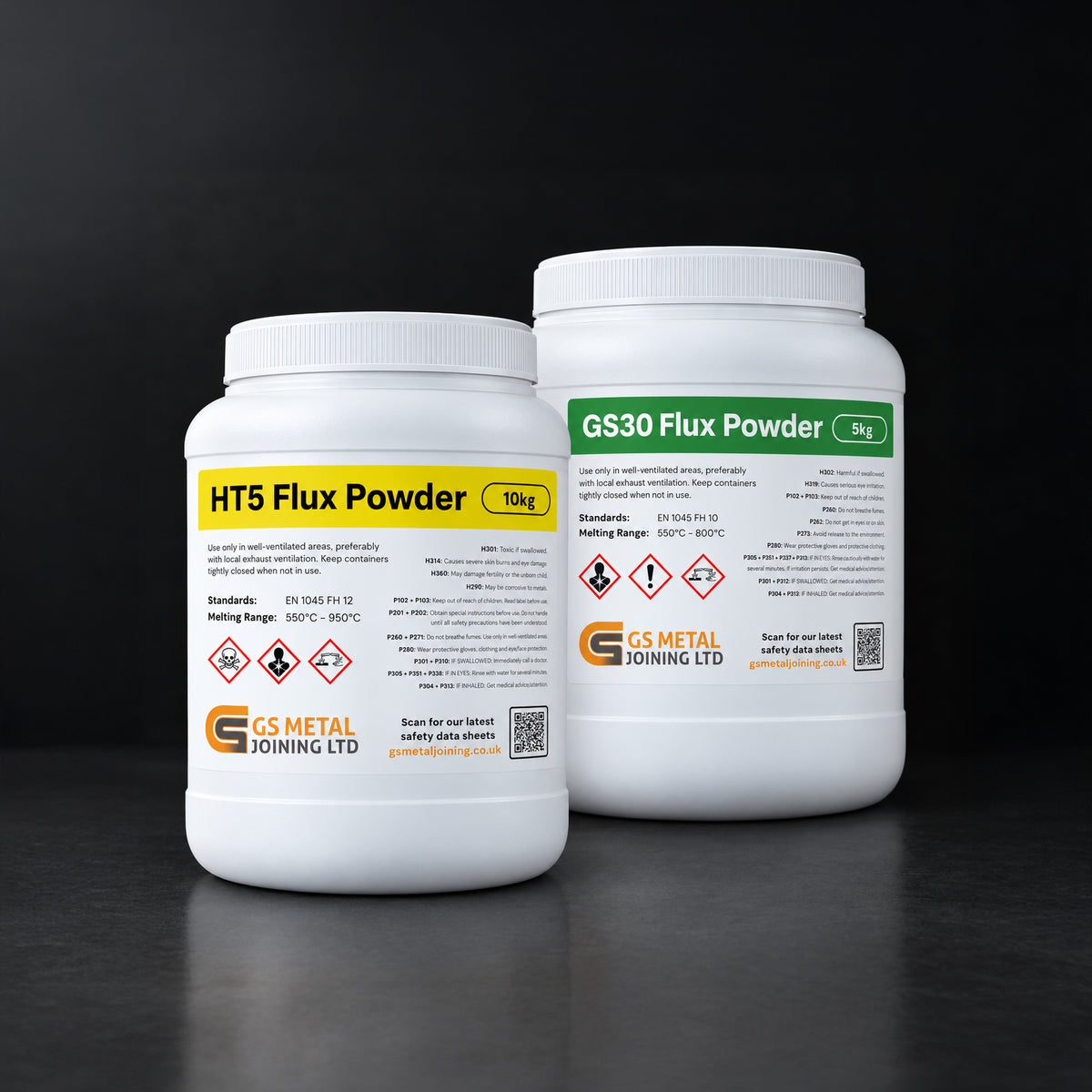
GS30FH10500–800°CPasteSilver brazing alloys on copper, brass, mild steel
GSHT5FH20700–1000°CPasteHigh-temperature alloys (AG206, AG207) on standard base metals
Stay-Silv WhiteFH10566–871°CPasteSilver brazing alloys on copper, brass, mild steel — extended active range
Stay-Silv BlackFH12566–982°CPasteStainless steel, nickel alloys, tungsten carbide — mandatory
600 Bronze FluxNot classified760–1200°CPowderBrass brazing and bronze welding with brass/bronze rods
  • GS30 — General purpose silver brazing flux

    FH10, active 500–800°C. Our standard general-purpose brazing flux — the correct specification for the majority of silver brazing applications on copper, brass and mild steel. Applied as a paste to the joint before heating. Turns clear and liquid at brazing temperature, indicating the joint is ready for alloy application. Use with AG103, AG105, AG107 and the full cadmium-free silver alloy range on standard base metals.

  • GSHT5 — High-temperature brazing flux

    FH20, active 700–1000°C. Formulated for high-temperature brazing alloys (AG206, AG207) on standard base metals where the brazing temperature exceeds the active range of GS30. The higher-activity formulation remains effective at temperatures up to 1000°C. Required when brazing above 800°C on copper, brass or mild steel — standard GS30 will be exhausted before the alloy reaches working temperature at these higher brazing temperatures.

  • Stay-Silv White — Extended-range silver brazing flux

    FH10, active 566–871°C. Paste flux with a wider active temperature range than GS30, providing more tolerance for variable torch technique or slower heating on larger assemblies. The extended upper active temperature (871°C vs 800°C for GS30) makes it a useful choice for larger joints where heat soak time is longer and the risk of flux exhaustion before the alloy reaches temperature is greater. Suitable for the full silver brazing alloy range on copper, brass and mild steel.

  • Stay-Silv Black — Stainless steel and carbide flux

    FH12, active 566–982°C. Mandatory flux for brazing stainless steel, nickel alloys and tungsten carbide. Specifically formulated to penetrate the stable chromium oxide layer on stainless steel and nickel alloys, and the chemically inert surface of tungsten carbide — neither GS30 nor Stay-Silv White is effective on these materials. Active to 982°C. Use with L-AG45SnSi for stainless steel and nickel alloys, and with AG206 for tungsten carbide.

  • 600 Bronze Flux — Brass brazing and bronze welding

    Not EN-classified, active 760–1200°C, powder form. Specifically formulated for brass brazing and bronze welding (oxy-acetylene process with brass/bronze filler rods) at temperatures above the range of silver brazing fluxes where a powder flux is the appropriate form. Applied by dipping the heated rod into the flux powder, which adheres to the rod and is carried into the joint. Not a substitute for paste flux in standard silver brazing — use GS30 or Stay-Silv White for those applications.

How to use brazing flux correctly

Flux works as a chemical barrier, preventing surface oxidation on the base metal during heating and allowing the brazing alloy to wet and flow into the joint. Using it correctly is as important as choosing the right grade:

  • Apply to a clean surface. Flux is not a substitute for cleaning — it cannot remove heavy grease, oil, scale or corrosion. Degrease and prepare the base metal before applying flux.
  • Apply before heating. Coat both mating surfaces and the immediately surrounding area with flux paste before applying any heat.
  • Watch the flux, not just the metal. As the joint heats, the flux will bubble, then turn clear and glassy — this indicates it is active and the joint is at brazing temperature. Apply the alloy at this point.
  • Do not overheat. If flux turns dark brown or black, it has been exhausted — the joint has been overheated. Allow to cool, clean off, re-apply flux and start again.
  • Remove flux residue after brazing. Flux residue is corrosive and must be removed after the joint has cooled. Quench in warm water and scrub off with a wire brush. Avoid quenching carbide joints — cool slowly.

Frequently asked questions

Which flux should I use for standard silver brazing on copper or steel?

GS30 (FH10, active 500–800°C) is the standard specification for silver brazing alloys (AG103, AG105, AG107, cadmium-free range) on copper, brass and mild steel. It is the correct flux for the vast majority of silver brazing applications. If you are brazing larger assemblies where heat soak time is longer and there is a risk of the flux being exhausted before the alloy reaches temperature, upgrade to Stay-Silv White (FH10, active to 871°C) for its wider active range.

Can I use GS30 on stainless steel?

No. GS30 is rated FH10 and active to 800°C — it is not formulated to remove the stable chromium oxide layer that forms on stainless steel at brazing temperatures. Using GS30 on stainless steel will result in poor alloy wetting and an unreliable joint. Always specify Stay-Silv Black (FH12, active to 982°C) for stainless steel, nickel alloys and tungsten carbide. Stay-Silv Black is the only flux in our range formulated for these base metals.

What is the difference between GS30 and Stay-Silv White?

Both are FH10 classification paste fluxes suitable for silver brazing on copper, brass and mild steel. The key difference is active temperature range: GS30 is active to 800°C, Stay-Silv White to 871°C. For most applications, GS30 is the standard choice. Stay-Silv White is the better specification for larger assemblies, slower heating with a small torch, or situations where the joint takes longer to reach brazing temperature and the risk of flux exhaustion before the alloy flows is greater. Neither is suitable for stainless steel, nickel alloys or tungsten carbide.

Do I need to remove flux residue after brazing?

Yes — all paste brazing fluxes leave a residue that is corrosive and must be removed after the joint has cooled. Allow the joint to cool to black heat, then quench in warm water and scrub off the residue with a wire brush. Do not quench tungsten carbide joints — the thermal shock can crack the carbide. For carbide, allow to cool slowly in still air and remove flux residue with warm water and a brush once cool. Flux residue left on joints in service will cause corrosion, particularly in damp environments.

When should I use GSHT5 instead of GS30?

Specify GSHT5 (FH20, active to 1000°C) when brazing with high-temperature alloys — primarily AG206 (800–830°C) or AG207 (820–870°C) on standard base metals such as mild steel. At these temperatures, GS30 (active to 800°C) will be exhausted before the alloy reaches working temperature, leaving the joint unprotected. GSHT5 remains active throughout the higher brazing temperature range. For standard silver alloys (AG103, AG105, AG107) on copper, brass and mild steel, GS30 is the correct and sufficient specification.

What is 600 Bronze Flux used for?

600 Bronze Flux (active 760–1200°C, not EN-classified) is a powder flux formulated for brass brazing and bronze welding — the oxy-acetylene process using brass or bronze filler rods on steel or cast iron — and for other high-temperature brazing applications where a powder flux is the appropriate form. It is applied by dipping the heated rod into the powder, which adheres and is carried into the joint. It is not a substitute for GS30 or Stay-Silv White in standard silver brazing work, where paste flux is the correct form.

  • Certified materials

    GS30, GSHT5 and Stay-Silv fluxes are classified to EN1045. Manufactured to consistent composition standards — fully COSHH compliant. Safety data sheets available on request for all products.

  • Technical expertise

    Over 110 years of combined experience across the full range of brazing and soldering processes. We advise on flux selection, process troubleshooting and base metal compatibility — including stainless steel, nickel alloys, carbide and aerospace applications.

  • Competitive pricing

    As a focused, efficient business with tightly controlled overheads, we offer genuinely competitive pricing at every order size — from individual tubs to volume trade and production quantities.

  • LINBRAZE partnership

    As UK representative of LINBRAZE S.R.L. of Italy, we provide access to a world-leading manufacturer of brazing pastes and specialist flux formulations — including products for automated and induction brazing processes.