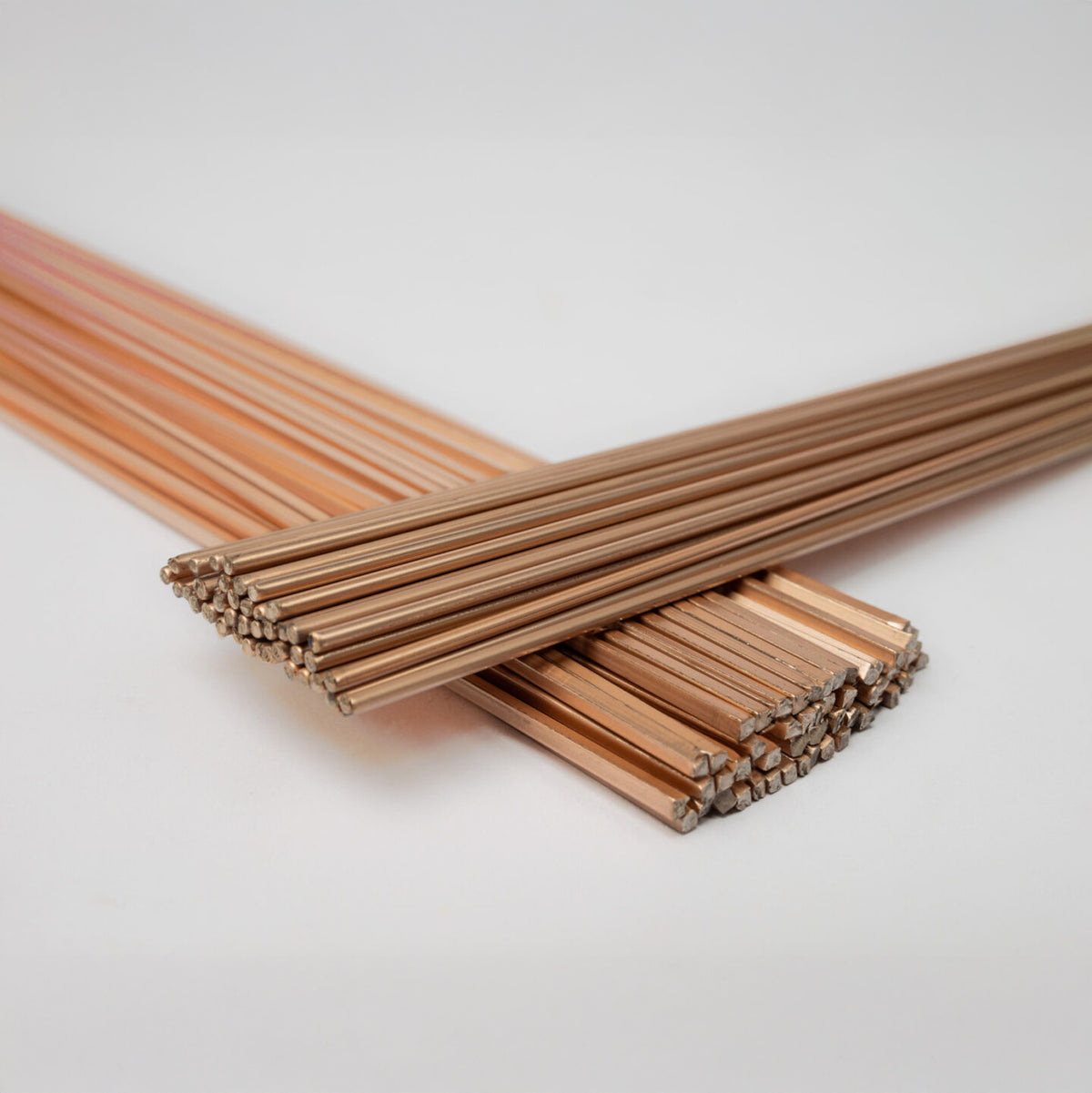
Silver Copper Phosphorus Brazing Alloys
GS Metal Joining supplies a full range of silver copper phosphorus brazing alloys, conforming to recognised international standards. These alloys are self-fluxing on copper in air, making them the practical and cost-effective choice for copper-to-copper joints in refrigeration, air conditioning, HVAC and plumbing applications.
The addition of silver to the copper phosphorus base reduces the melting point, improves fluidity and increases the ductility and strength of the finished joint compared to no-silver copper phosphorus grades. All alloys are available as rods, wires, preforms, powders and pastes.

Alloy specifications
All CP grades conform to EN1044. Self-fluxing on copper — flux is not required for copper-to-copper joints. Flux is required on brass. Do not use on ferrous metals or nickel alloys — phosphorus reacts with iron and nickel to form brittle intermetallic phases. The silver additions in this range (compared to standard copper-phosphorus alloys) lower the melting point and improve flow and joint ductility — the higher the silver content, the greater the benefit.
| Grade | % Silver | % Copper | % Phosphorus | Melting range | Key characteristic |
|---|---|---|---|---|---|
| CP101 | 18 | 75 | 7.0 | 645°C | Highest silver — eutectic, single melting point |
| CP102 | 15 | 80 | 5.0 | 645–800°C | High silver, best joint ductility |
| CP103 | 6 | 86.7 | 7.3 | 645–725°C | Mid silver, narrow melting range |
| CP104 | 5 | 89 | 6.0 | 645–815°C | General-purpose silver grade |
| CP105 | 2 | 91.7 | 6.3 | 645–825°C | Entry-level silver addition |
| Dynaflow | 6 | 87.9 | 6.1 | 645–795°C | Branded grade, close to CP103 |
Choosing the right grade
-
CP101
18% silver, 7.0% phosphorus, 645°C. The highest-silver grade in the range. A eutectic composition — it melts at a single temperature with no pasty phase, giving the lowest brazing temperature and excellent fluidity. Ideal for close-tolerance joints and for automated or induction brazing where precise, predictable flow is critical. Self-fluxing on copper.
-
CP102
15% silver, 5.0% phosphorus, 645–800°C. High silver and the lowest phosphorus content in the range give the best joint ductility. The preferred specification for joints subject to vibration, thermal cycling or pressure fluctuation — including refrigeration, air conditioning and HVAC pipework. Self-fluxing on copper; GS30 flux required on brass.
-
CP103
6% silver, 7.3% phosphorus, 645–725°C. A mid-silver grade with a narrow melting range for its silver content, giving good flow and wetting on copper. A cost-effective general-purpose grade for copper pipework and a good choice for field brazing. Self-fluxing on copper.
-
CP104
5% silver, 6.0% phosphorus, 645–815°C. A widely used general-purpose silver-bearing grade. Better flow and joint ductility than no-silver grades, while keeping silver content — and cost — moderate. Suited to standard copper pipework in refrigeration, HVAC and plumbing. Self-fluxing on copper; GS30 flux required on brass.
-
CP105
2% silver, 6.3% phosphorus, 645–825°C. The lowest silver content in the range. The small silver addition gives a modest improvement in ductility and wetting over no-silver copper phosphorus grades at minimal extra cost. The wide melting range helps fill wider or less consistent joint gaps. Self-fluxing on copper.
-
Dynaflow
6% silver, 6.1% phosphorus, 645–795°C. A Harris silver copper phosphorus grade, supplied through our Harris partnership, close in composition to CP103. Flux-cored wire format that combines the alloy and flux in a single product — eliminating the separate flux application step. Designed for high-speed production brazing of copper assemblies where process efficiency is a priority. The flux core provides protection on brass as well as copper, making Dynaflow suitable for mixed copper/brass assemblies in a single operation.
Silver-copper-phosphorus vs standard copper-phosphorus — which should I specify?
Both ranges are self-fluxing on copper and suitable for capillary brazing of copper pipework and assemblies. The silver additions in CP101–CP105 deliver three practical advantages over standard copper-phosphorus grades (CP201–CP203):
- Lower brazing temperature — the silver addition lowers the melting point, allowing brazing at lower heat input. CP101 in particular melts at 645°C, well below CP201 (710–770°C).
- Improved joint ductility — silver reduces the brittleness associated with the phosphide phase. Where joints will be subject to vibration, thermal cycling or mechanical stress in service, the higher-silver grades CP101 and CP102 produce more reliable long-term performance.
- Better flow in difficult geometry — higher-silver grades, particularly the eutectic CP101, give better capillary fill in tight, complex or automated joints.
For straightforward, low-stress copper-to-copper joints where cost is the primary driver, standard copper-phosphorus (CP201, CP202 or Phoson) remains the practical choice. Specify the silver-copper-phosphorus range where the application justifies it.
Frequently asked questions
Do silver-copper-phosphorus alloys need flux on copper?
No — like standard copper-phosphorus alloys, the phosphorus content acts as a self-fluxing agent on copper and copper alloys. No separate flux is needed for copper-to-copper joints. Flux is required if you are brazing copper to brass. These alloys must not be used on ferrous metals or nickel alloys — phosphorus reacts with iron and nickel to form brittle intermetallic phases that compromise joint integrity.
What is Dynaflow and when should I use it?
Dynaflow is a Harris flux-cored wire combining a silver copper phosphorus alloy close to CP103 (6% silver, 6.1% phosphorus, 645–795°C) with an integrated flux core. It eliminates the separate flux application step, making it particularly suited to high-speed production brazing where process efficiency matters. Because the flux core also provides protection on brass, Dynaflow is a convenient choice for mixed copper and brass assemblies where switching between flux and no-flux is otherwise required. It is not self-fluxing in the same sense as bare rod — the flux is integral to the wire, so it must be used as supplied.
Which grade is best for automated or induction brazing?
CP101 (18% silver, 645°C) is the preferred specification for automated and induction brazing processes. It is a eutectic composition — it melts at a single temperature rather than over a range — so the alloy transitions sharply from solid to liquid with no pasty phase, giving precise control over flow timing. This is important in automated processes where the heat cycle is fixed and flow behaviour must be predictable. Contact us to discuss your specific process parameters.
Why are these alloys not suitable for nickel or ferrous metals?
Phosphorus reacts with both iron and nickel at brazing temperatures to form brittle intermetallic phases — iron phosphide and nickel phosphide respectively — at the joint interface. These phases significantly reduce joint strength and ductility, making the joint unreliable in service. For nickel alloys, specify L-AG45SnSi with Stay-Silv Black flux. For copper-to-steel joints, specify a standard silver brazing alloy (AG103 or AG105) with GS30 flux.
When should I upgrade from CP104 to CP102 or CP101?
Upgrade to CP102 (15% silver) or CP101 (18% silver) when one or more of the following apply: the joint will be subject to vibration, thermal cycling or mechanical stress in service; joint geometry is tight or complex and requires maximum capillary flow; minimum heat input is a requirement (CP101 melts at a single 645°C, reducing the heat-affected zone); or the process is automated and precise flow control is needed. For straightforward copper-to-copper production joints without these demands, CP104 (5% silver) is the most cost-effective choice.
Are these alloys RoHS and COSHH compliant?
Yes. All silver-copper-phosphorus alloys in our range are manufactured from virgin raw materials and are fully RoHS and COSHH compliant. They contain no cadmium, lead or other restricted substances. Safety data sheets are available on request.
Why Choose GS Metal Joining?
-
Certified materials
All silver-copper-phosphorus alloys conform to EN1044. Manufactured from virgin raw materials — fully RoHS and COSHH compliant. Certification available on request.
-
Technical expertise
Over 110 years of combined experience in silver soldering and brazing. We advise on grade selection, process optimisation and specification compliance — including automated and induction brazing applications.
-
Competitive pricing
As a focused, efficient business with tightly controlled overheads, we offer genuinely competitive pricing at every order size — from small users to high-volume production operations.
-
LINBRAZE partnership
As UK representative of LINBRAZE S.R.L. of Italy, we provide access to a world-leading manufacturer of metal powders and brazing pastes — including specialist silver-copper-phosphorus formulations and bespoke preform production.